
As a company grows, an informal management model stops working
We clarify roles, decision-making and the rules for working together within the company so that the management board can operate more efficiently, owners have greater control, and the organisation does not lose time to unclear divisions of responsibility, tensions and uncertain accountability.

A lack of clear rules begins to consume management board time, slow operations and resurface whenever a significant ownership or supervisory matter arises.
The larger the company, the more costly a lack of clear operating rules becomes. Well-designed corporate governance should reduce the burden on the management board, structure owner relations and give the company a predictable decision-making framework.

Mateusz Sawaryn
Managing Partner Counsel
Our solution
What exactly the service provides
This is not a document review or a set of general recommendations. We design and implement a corporate operating model that structures responsibilities, decisions, ownership relations and the day-to-day work of the corporate bodies. The result should be governance that works in practice-not only on paper.
Map of gaps, tensions and risks
We analyse the company’s structure, documents, the roles of its corporate bodies, ownership relations and how decisions are actually made.
A clear division of roles and responsibilities
We structure the operating rules for the management board, supervisory board and shareholders, as well as the limits of their responsibilities.
Practical rules for cooperation between shareholders
We turn owners’ expectations into practical rules for exercising influence, agreeing key matters and resolving tensions.
A clear decision-making workflow within the company
We determine which matters go to the management board, which require owner or supervisory approval, and how to document the decision-making process.
A package of ready-to-use documents
We prepare or update rules of procedure, policies, resolutions, reporting rules and other corporate governance documents.
A coherent set of tools that support management instead of creating another layer of formalities.
Day-to-day working standards for corporate bodies
We establish working cycles, a calendar, standards for materials and checklists for ongoing cooperation between the management board, supervisory board and owners.
Simpler organisation of work and less reliance on individual people’s memory.
Implementing and refining the model in practice
We help put the new operating framework into practice and refine it where business needs indicate that changes are required.
Who this service is for
For companies that no longer want to manage by instinct
This service is for organisations that recognise the company has outgrown its informal operating model. There are more decisions and greater responsibility, while the existing way of working begins to create bottlenecks, tensions and risk.

The company grows while decisions slow down
The company is growing quickly, and new shareholders, an investor or a supervisory board appear. The existing operating model begins to slow decisions and limit the management board’s ability to act.
Responsibility is no longer clear
In a mature company, disorganised governance begins to pose a real risk to the management board, owners and business value. The company needs management stability, greater control and a predictable operating model.
Knowledge is fragmented
Operationally, resolutions, materials, meetings and communication with the corporate bodies must all be handled, but currently everything relies on improvisation and the memory of individual people.
Stages of our work
How we run the project
The process is designed to identify the real problem quickly, translate the findings into a target operating model and help put it into practice-without placing an unnecessary burden on the client’s team.
Assess and map priorities
We review the company’s structure, governing bodies, ownership relationships, documents and actual decision-making. We examine how the company truly operates, not just its paperwork.
Design the target governance model
We recommend a governance model that fits the company’s scale, operating pace and ownership structure. We define governing-body roles, workflows and collaboration rules.
Documents and operational implementation
We translate decisions into bylaws, policies, resolutions, procedures and working standards, making them usable as well as formally sound.
Stabilize operations
We support initial decisions, communication between governing bodies and adjustments where practice requires them.
Contact us
Identify what should be put in order before the problem returns with the next important decision
Confusion over responsibilities does not disappear by itself. It usually resurfaces precisely when the stakes are highest: during a significant management board decision, tensions between shareholders, an ownership change or entry into a new stage of growth.
In a few points, describe how the management board, shareholders and decision-making workflow currently operate in your company. In response, we will identify the elements that most need to be structured and suggest a sensible next step.
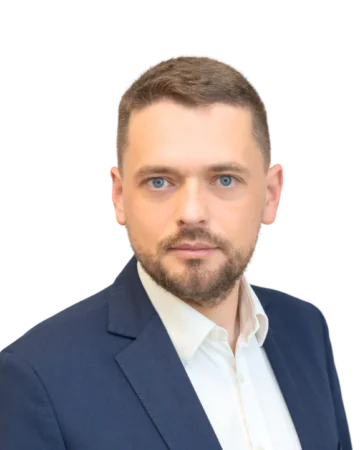
Mateusz Sawaryn
They will follow up with any questions or recommend a next step.
Quick response
We usually respond within two hours on business days.