

Note: the latest analysis of how to benefit from Polish Deal 2.0 is available here.
The Polish Deal was due to take effect on 1 January 2022, bringing tax increases that entrepreneurs were expected to feel most. Depending on individual circumstances, taxes for sole proprietors could rise by as much as 9%.
People receiving remuneration for appointment to a management board of a Polish limited liability company (sp. z o.o.) and partners in Polish partnerships would also pay more.
Could anything be done to avoid the higher taxes? The article describes lawful ways to reduce the effects of the Polish Deal and, in some cases, benefit from its rules. The options are set out below.
Switching to lump-sum tax on recorded revenue
The first option is expressly provided for by the Polish Deal. From 1 January 2022, lump-sum tax rates and rules were to change, which could itself be beneficial for many people. The best results, however, could come from combining the lump-sum system with a Polish limited liability company (sp. z o.o.), as discussed later.
Two new, favorable lump-sum tax rates were introduced:
- A 14% rate for doctors and other healthcare workers, architects, and people providing specialist planning services; and
- A 12% rate for IT specialists and programmers.
The mandatory health insurance contribution must be added to these rates. It was divided into 3 groups:
- PLN 317 if annual earnings were up to PLN 60,000;
- PLN 529.72 if annual earnings exceeded PLN 60,000 but did not exceed PLN 300,000; and
- PLN 953.49 if annual earnings exceeded PLN 300,000.
How would this work in practice? If a programmer earned PLN 180,000 net per year (PLN 15,000 net per month) on invoices, and this was all of their revenue, choosing lump-sum tax would mean:
- Paying 12% income tax, or PLN 21,600 per year; and
- Paying PLN 6,356.64 in health insurance contributions per year.
The effective tax burden on income would therefore be 15.53%, which the article described as reasonable. After adding full ZUS social insurance contributions and accounting costs, it would be approximately 24.4%, still relatively low given the full ZUS burden.
This option is generally worthwhile only for people with no costs, where revenue is practically equal to income. Under lump-sum tax, tax is charged on revenue, without deducting costs. For anyone with medium or high costs, lump-sum taxation therefore does not make sense.
In that situation, combining a sole proprietorship with a limited liability company is likely to be a better option.
Invoicing your own limited liability company
The first practical way discussed for optimizing the Polish Deal for a business with significant costs is to form a limited liability company while keeping the sole proprietorship.
The business activity is then transferred to the newly formed company: the company starts making sales and recording revenue, and its costs are transferred as well. It is important for the company to bear all costs it can. A limited liability company pays corporate income tax (CIT) at 9% or 19%, calculated on income. If costs eliminate the income, there is no tax on that income.
To reduce the company’s income further, the owner’s sole proprietorship can invoice the company. Providing services to one’s own company is lawful; the article discusses this in more detail in this article about withdrawing money from a limited liability company without double taxation.
The sole proprietorship would use lump-sum taxation because it would no longer have costs: all costs would be borne by the company.
Consider this calculation: annual revenue of PLN 500,000, costs of PLN 250,000, and net income of PLN 250,000.
After the Polish Deal took effect, total taxes and charges, including full ZUS and accounting costs, would be 29.6% under the flat tax, leaving approximately PLN 176,000.
If the business instead used a limited liability company and lump-sum tax, and invoiced the company for PLN 250,000:
- At a 14% lump-sum rate, the total burden would be 21.7%, leaving PLN 186,500.
- At 12%, the burden would be 19.7%, leaving PLN 191,500.
- At 8.5%, the burden would be 16.2%, leaving PLN 200,000.
- At 5.5%, the burden would be 13.2%, leaving PLN 207,000.
- At 3%, the burden would be 10.6%, leaving PLN 213,000.
As shown, the annual savings could reach PLN 37,000, or more than PLN 3,000 per month. The article states that many service businesses could use the 8.5% rate, manufacturers and construction businesses the 5.5% rate, and, among others, food-service and trading businesses the 3% rate.
Importantly, these calculations already include the additional accounting cost of a limited liability company.
There were further ways to reduce the total burden, including using the tax-free allowance and paying remuneration under the company’s articles of association (Article 176 of the Commercial Companies Code).
Combining a limited liability company with a sole proprietorship, board appointment remuneration, and remuneration under the articles of association
As noted above, money can be withdrawn from a limited liability company in different ways. See the article on payments from a limited liability company.
The approach is to develop additional ways of withdrawing funds so the company’s costs increase while the payments are taxed as efficiently as possible. The article stresses that these methods must comply with the applicable limits, which are discussed in the article on withdrawing funds from a limited liability company.
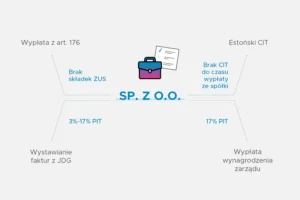
Two basic options are remuneration for serving on the management board and remuneration under Article 176 of the Commercial Companies Code for recurring non-cash benefits provided to the company.
Both types of remuneration are taxed under the progressive scale and are added together. The combined total of the two types of remuneration must not exceed PLN 120,000 per year if you want to stay below the second tax bracket.
The suggested approach was:
- Set management board appointment remuneration at PLN 30,000 per year. Under the tax-free allowance, no income tax would be paid on that remuneration, only the 9% health contribution. From 2022, a health contribution was payable on management board members’ remuneration.
- Pay a further, for example, PLN 30,000 under Article 176. The article states that this remuneration was not subject to the health contribution and would therefore bear only 17% income tax.
The remuneration must be justified and genuine, not fictitious. The arrangements should be carefully considered and supported with reasons.
Returning to the earlier example, the source states: revenue of PLN 500,000, costs of PLN 250,000, and income of PLN 250. A sole proprietor would keep approximately PLN 176,000 after ZUS and accounting costs.
If the business used a limited liability company, paid PLN 30,000 for board service and another PLN 30,000 under Article 176, and invoiced the company for PLN 190,000, the results would be:
- At a 17% lump-sum rate, a 21.5% total burden and PLN 187,000 remaining.
- At 14%, a 19.3% burden and PLN 192,000 remaining.
- At 12%, a 17.8% burden and PLN 196,000 remaining.
- At 8.5%, a 15.2% burden and PLN 202,000 remaining.
- At 5.5%, a 12.9% burden and PLN 207,500 remaining.
- At 3%, an 11% burden and PLN 212,000 remaining.
Each case requires its own calculation. Different revenue, costs, and available lump-sum rates may make other variations appropriate. As a general rule proposed in the article, this type of optimization could be possible and beneficial where costs are around 30% to 70% of revenue.
A limited joint-stock partnership as a way to avoid health insurance contributions
Warning: the source marks this information as outdated.
The article described operating as a limited joint-stock partnership as the most radical method, but also the one offering the greatest savings. Partners in this type of partnership do not pay ZUS contributions, and general partners may proportionally deduct the partnership’s CIT paid from their personal income tax (PIT), as described for limited partnerships in this article.
For the earlier calculation, the source gives revenue of PLN 500,000, costs of PLN 250,000, and income of PLN 205. It states that the tax burden would be 17.3%, leaving approximately PLN 197,000. It describes this as a fixed burden that could suit people with high income, particularly because the 4% solidarity levy would not apply, and people whose only available lump-sum rate was 17%.
For example, a person with revenue of PLN 2.5 million and costs of PLN 1 million:
- Would pay approximately 26.1% while continuing as a sole proprietor, leaving around PLN 1.1 million.
- Would pay approximately 20% to 24%, depending on the lump-sum rate, using the limited liability company arrangements described above, leaving between PLN 1.12 million and PLN 1.16 million.
- Would pay 17.3% in a limited partnership and keep approximately PLN 1.23 million, more than PLN 100,000 extra.
The difference would generally grow with revenue and income. At revenue of PLN 4.5 million and costs of PLN 2 million, the difference could reach PLN 250,000.
Each situation must be examined individually. The article also cautions that this arrangement assumes no ZUS contributions are paid, so no pension contributions are accumulated.
A limited joint-stock partnership could be formed by one person, who could be both its general partner and shareholder. The article presented this as a potentially suitable option for sole proprietors with substantial income.
How to protect yourself from the Polish Deal
The tax changes described above offered several ways to optimize tax lawfully.
The calculations are examples only. Each case requires consideration of, among other things, the so-called hidden dividend and the entrepreneur’s individual circumstances.
The calculations may differ substantially where, for example, the entrepreneur has another basis for ZUS coverage through employment, or exceeds the revenue threshold for the 9% CIT rate.
The way a business moves from a sole proprietorship to a company also matters. Some can form a new limited liability company and transfer the business efficiently; others must convert the existing sole proprietorship into a limited liability company. In the latter case, the company cannot immediately use the 9% CIT rate. The article notes, however, that the change may still be beneficial: if the company bears most costs, the higher CIT rate may not matter and the total burden may remain lower than for a sole proprietorship.
If you would like us to assess your situation in relation to the Polish Deal and potential tax planning, write to us.