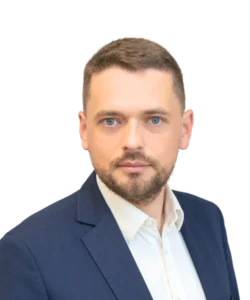
This interview with Dr. Tomasz Goliński, Managing Partner at Cofunder Zone VC, answers questions about startup valuation, investor choice, working with a VC and common founder mistakes. It appeared in the “2022 Report: Startups and IT Companies in the Podbeskidzie Region,” prepared and published by the Startup Podbeskidzie Foundation (download it here).
Cofunder Zone is a group of angel investors, experienced entrepreneurs, business owners and managers. It connects investors with knowledge and capital to innovative entrepreneurs looking for opportunities to grow.
What is a venture capital fund and how does it work?
A venture capital fund finances innovative companies. In exchange for capital, it takes a minority stake in a startup.
Types of VC funds
- Seed funds invest at the earliest stage of a company’s development.
- Growth funds invest in companies that are already growing and generating revenue.
- Post-revenue funds finance companies with proven sales.
- Corporate VC funds pursue goals set by corporate investors.
Each fund follows an investment strategy that its management team implements throughout the fund’s life, usually 8 to 10 years.
The two sides of working with a VC fund: startup and investor
A VC fund has two groups of stakeholders:
- Investors entrust capital to the fund to grow it, accepting a higher level of risk.
- Startups receive funding and become part of the fund’s portfolio.
Cofunder Zone’s co-investment model
Cofunder Zone uses a model in which:
- 50% of the capital comes from the fund.
- 50% of the capital is invested directly by business angels.
- Private investors decide for themselves which company to invest in and to what extent.
Remember: diversifying risk is fundamental to VC investing. Invest across a larger number of companies rather than in just one.
Where to start when raising VC funding
Prepare before you start looking for capital:
- Research the investor market: review fund strategies and match an investor to your startup’s stage of development. More than 100 funds with different profiles operate in Poland.
- Decide how much capital you want to raise and how you will use it.
- Define milestones you expect to reach with the funding.
- Decide what support you expect beyond money, such as contacts, industry knowledge or help with recruitment.
How much can you raise from a VC fund?
Each fund has a defined investment ticket, the maximum amount it will invest in one company. The ticket depends on the fund’s size and investment strategy.
| Fund type | Investment range |
|---|---|
| Seed funds | From several hundred thousand to several million PLN |
| Growth funds | From a dozen or so million to several dozen million PLN |
Equity dilution: what to watch
Every issue of shares or stock to bring in an investor affects the dilution of existing shareholders’ ownership structure (the cap table). If you give away too much equity early on, you may lose control of the company. That is why an appropriate valuation is a starting point.
How to value a startup before an investment round
The valuation method depends on the company’s stage of development:
Pre-revenue startup
- Consider the market potential.
- Take into account the size of the planned investment round.
Startup generating revenue
- Analyze the growth rate and revenue level.
- Prepare financial forecasts.
- Look for comparable companies. They do not have to be direct competitors; companies in the same industry or with a similar business model may be enough.
Macroeconomic conditions affect valuations. Greater investor caution means a closer analysis of a company’s value, both by the startup and by the fund.
What a startup can expect from a VC fund beyond money
One of the biggest challenges in Poland’s VC market is limited access to smart money: the value an investor contributes in addition to capital.
What Cofunder Zone offers as smart money
- Support from business angels: professional experience, industry knowledge and contacts
- Help raising subsequent investment rounds
- Support for international expansion
- Recruitment for roles with a significant impact on company growth
- Corporate governance and legal support
- Experience with exits: the team has many years of experience in capital markets and investment banking
Common mistakes startups make when seeking VC funding
Before choosing VC funding, make sure you understand what you are agreeing to:
- Financial investors will expect the company’s value to grow quickly.
- The fund expects to exit the investment after a defined period by selling its shares.
- You will need to maintain a high growth rate and meet successive milestones.
Takeaway: If you plan to run a micro-scale business and do not want to scale rapidly, VC funding is not the right path.
How a VC assesses an investment
When assessing a project, a fund reviews:
- the business idea and its effect on the surrounding environment
- the business model
- market potential
- financial data and how the company is funded
- the team, the factor given the greatest weight
Why is the team most important? Execution and motivation determine whether the people behind the idea can seize an opportunity in good times and limit losses during a crisis.
What working together looks like after an investment
Kick-off meeting
After closing a transaction, Cofunder Zone meets with the company and the co-investing business angels. The meeting aims to:
- confirm short- and long-term goals
- identify the company’s challenges
- match support to the company’s needs, using investors’ resources or networks
Ongoing monitoring
- Monthly status meetings to track progress and plan next steps, including preparation for later rounds
- Budget as a monitoring tool to track revenue and cost metrics
The fund is flexible about changes proposed by the founders. An innovative project is a living process, and its plan has to adapt to reality.
What happens if a project fails?
If a company is dissolved or declared bankrupt, this is usually preceded by many actions and the exhaustion of other options.
A pivot as an alternative to failure
A pivot is a change in the direction or business idea pursued by a team. A successful pivot requires:
- Early recognition of a problem, before resources run out
- Skill in identifying market opportunities
- Willingness to reshape the company
- Open communication with investors, which allows the project to be managed flexibly and losses to be limited
Outlook for startups in small and mid-sized cities
The pandemic showed that where you develop a project does not matter.
Cities such as Bielsko-Biała are becoming more attractive because they offer a better balance between quality of life and living costs than cities such as Warsaw. Cofunder Zone does not use geography as an investment criterion in Poland.
What holds back startup growth in Poland?
There are two problems:
- Limited later-stage funding, in the range of several to a dozen or so million euros. Poland has too few growth funds with investment tickets of this size.
- Too much focus on the local market: startups can be caught by a relatively large customer base in Poland and forget to internationalize. This can close the door to funds in mature Western markets.
Which industries attract VC investors?
VC funds are most interested in business models with the potential to scale quickly:
- B2B SaaS
- Marketplaces
- Fintech
- Foodtech
- Gaming
- E-commerce
In Poland, these industries have an additional advantage: strong consumer purchasing power and the presence of large companies that may buy solutions from innovative businesses.
Is VC investing a good option for private investors?
Cofunder Zone works with a network of more than 200 business angels from Poland and abroad.
How the co-investment model works for business angels
- Transactions are made on a deal-by-deal basis, so the investor chooses the company.
- The business angel directly acquires shares and participates in the round in a 1:1 ratio with the fund.
- On exit, any potential surplus is shared 65:35 in favor of the business angel.
- The fund manages the entire process: due diligence, negotiations over the investment agreement and portfolio management.
Tax relief for business angels
Since 2022, a tax relief has allowed investors to deduct 50% of the investment amount from the tax base. The regulation remains in force today.
What next?
If you would like to discuss the legal aspects of running a startup or consult on a specific issue involving your company, get in touch. Together, we can find a suitable path for your business to grow.
You can also listen to an interview prepared by the Polish Agency for Enterprise Development as part of its SME Development Center project:
Frequently asked questions
How does startup funding from a venture capital fund work? A venture capital fund finances innovative companies and takes a minority stake in a startup in exchange. Each fund follows an investment strategy implemented by its management team throughout the fund’s life, usually 8 to 10 years. Funds differ in the stage at which they invest, from seed funds at the earliest stage through growth funds to corporate VC funds pursuing corporate investors’ goals.
How should you prepare to raise funding from a VC fund? Start by researching the investor market. More than 100 funds with different profiles operate in Poland, so match a fund to your startup’s development stage and its investment strategy. Decide how much capital you want to raise and how you will use it, define the milestones you expect to reach, and decide what support you want beyond money, such as contacts, industry knowledge or recruitment help.
How should you value a startup before a VC round if it has no revenue yet or is just starting to earn revenue? If your startup has no revenue yet, consider market potential and the size of the planned investment round. If it already generates revenue, analyze its growth rate and revenue level, prepare financial forecasts, and look for comparable companies in the same industry or with a similar business model. Remember that every share issue to bring in an investor dilutes existing shareholders. If you give away too much early on, you may lose control of the company.
What does a VC fund focus on most when making an investment decision? A fund analyzes the business idea and its impact, the business model, market potential and financial data, but gives the greatest weight to the team. Execution and motivation determine whether the people behind the idea can seize opportunities in good times and limit losses during a crisis.
When is VC funding not a good solution for a startup? If you plan to run a micro-scale business and do not want to scale rapidly, VC funding is not the right path. Financial investors expect the company’s value to grow quickly, milestones to be achieved at a fast pace, and an exit through the sale of shares after a defined period. You need to be ready for these conditions before choosing a round.